
Every pilot learns the same hard truth early: the landing starts long before the wheels touch. Pick the wrong strip, the wrong end, or the wrong aimpoint, and the rest of the approach becomes a recovery. Spacecraft face a sharper version of that problem. On the Moon or Mars there is no tower, no NOTAMs, and often no second chance once the descent has committed.
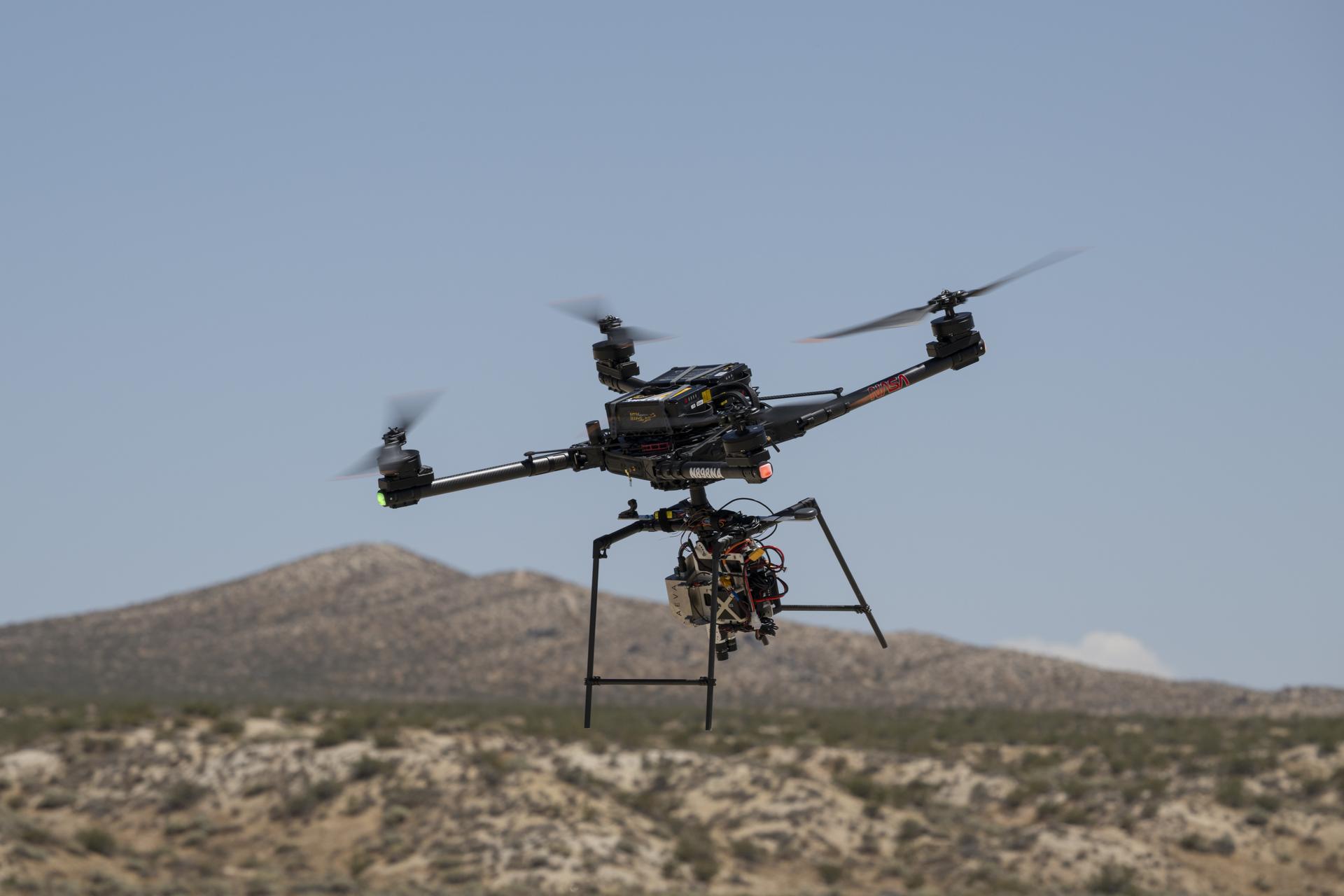
On Nov. 4, NASA’s Armstrong Flight Research Center reported a new flight-test result aimed squarely at that problem. An Alta-X remotely piloted aircraft carrying the agency’s Safe and Precise Landing – Integrated Capabilities Evolution, or SPLICE, guidance and navigation payload completed simulated lunar descent and landing maneuvers on Aug. 27 at Rogers Dry Lake near Edwards, California. The run is part of a multi-year effort to give landers the judgment a good pilot brings to a short field: see the surface, decide if it is safe, and divert if it is not.
What SPLICE is built to do
SPLICE is a guidance, navigation, and control payload developed by researchers at NASA’s Johnson Space Center in Houston. In the Armstrong tests, the system used an advanced guidance package to map the terrain below the drone and assess potential landing areas. If the targeted touchdown zone looks unsafe, the system is designed to divert the vehicle to a safer location. NASA says the payload generates high-resolution digital elevation maps from light-detection and ranging and related sensor data — the kind of dense surface picture a crew or an autonomous lander needs when rocks, slopes, or shadows can ruin a soft touchdown.
That capability is not abstract for lunar and Mars missions. Soft landings on either body depend on knowing where the ground really is and whether the final aimpoint is clear. A divert decision made a few seconds too late is a crater. A divert made early enough is just another approach.
From lab to lakebed
Armstrong specialists partnered with the Johnson team to integrate, test, and fly SPLICE aboard the Alta-X drone in June and July. Those earlier flights verified communications, data handling, telemetry, and command-and-control performance between the payload and the aircraft. That work prepared the project for a full-scale test at Voyager Technologies in Mojave, California, later in the period covered by the Nov. 4 report.
Project manager Davis Adams framed the Aug. 27 result as more than a single successful sortie. “This flight test is the culmination of almost a decade of work, for the SPLICE project,” Adams said in the NASA release. “This flight raised the technology readiness level, priming it for integration into future robotic and crewed lunar flights. Validation of the guidance and navigation systems are applicable to terrestrial, lunar, and Martian descent and landing missions.”
In aviation terms, that is the moment a prototype stops being a lab demo and starts looking like something you could hang on an operational vehicle.
Why flight research matters here
SPLICE did not appear overnight. NASA’s Flight Opportunities project, based at Armstrong, enabled earlier flight testing that raised the system’s readiness over several years. According to NASA, those campaigns included a 2019 descent-altitude and landing-trajectory demonstration similar to what a lunar mission would see, and a 2020 demonstration of two NASA-developed precision landing sensor systems. The Alta-X work continues that Armstrong tradition: put the hardware on a flying machine, gather real telemetry, and find the problems you cannot see on a bench.
The agency also notes that it has worked with commercial lunar lander providers to implement iterations of SPLICE on their platforms. NASA says a number of landers slated for upcoming Moon Base missions already draw on data collected through the development of systems like SPLICE to execute soft touchdowns. Adams added that the team is coordinating with industry on use of the guidance system once it is available in the NASA software catalog, planned for the fall covered by the release, and that some companies are evaluating the navigation capabilities for precision landing and possible extensions to autonomous surface mobility.
The Skylord angle
From the flight-test lakebed to a future lunar pad, the story is familiar to anyone who has scrubbed an approach for a better runway. Precision landing is not only about better sensors. It is about closing the loop between what the vehicle sees and what it decides to do before it is too late. SPLICE’s divert logic is that loop written in software and proven, for now, on a drone over Rogers Dry Lake.
For Skylord Radio listeners and magazine readers who care about how airplanes and spacecraft actually get built and proven, this is the kind of quiet milestone that matters: a guidance package that can map, judge, and change its mind in flight. The X-planes and research aircraft that made American aeronautics famous did the same thing in their eras — fly the idea, measure it, then hand a better idea to the next vehicle.
NASA’s Nov. 4 update does not claim the Moon is solved. It claims something more useful: the technology readiness level moved, industry is already looking at the code, and the same principles apply whether the landing site is a dry lake in California or a crater rim near the lunar south pole.
Sources
- NASA Armstrong: NASA Navigation Experiment Shows Promise for Planetary Landings (Nov. 4, 2026)
- NASA image AFRC2026-0152-30 (NASA/Ryan Kline)
Featured image: An Alta-X drone flies the SPLICE experiment near NASA’s Armstrong Flight Research Center in Edwards, California, on July 15, 2026. Credit: NASA/Ryan Kline



No comment