
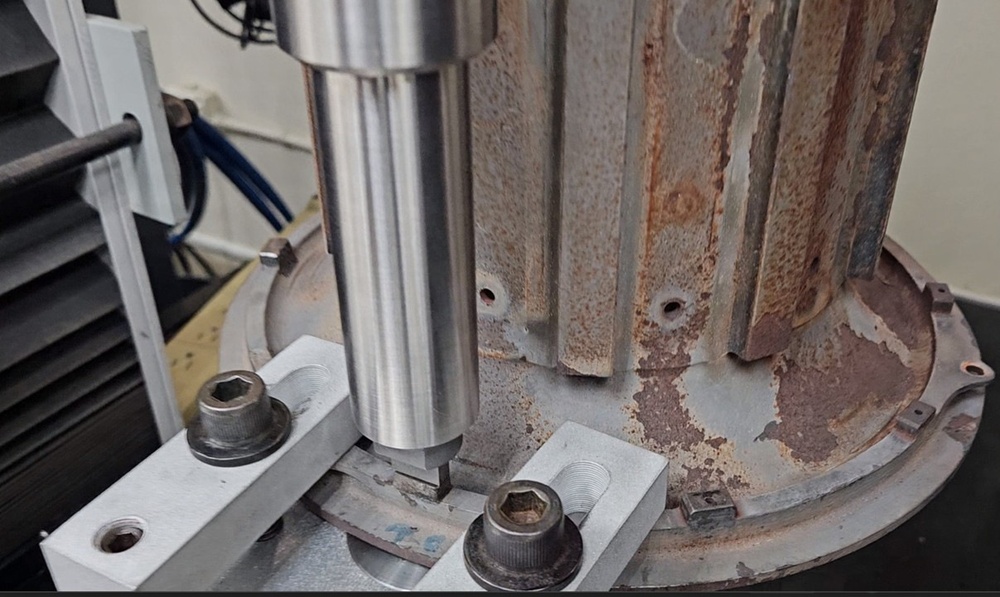
The Navy’s Fleet Readiness Center Southwest has developed a robotic laser-based repair for worn tabs on the F/A-18 Super Hornet’s braking torque tube assembly, a component of the main landing gear. The command says the recurring repair is expected to cost about $4,000, compared with roughly $46,000 to replace the full assembly. The process is intended to restore the worn tabs and keep the larger unit in service.
The repair was described in a Nov. 3 report from Naval Air Systems Command, with the same report distributed through DVIDS. Independent technical outlet Make Tech Easier reviewed the repair, testing figures and cost estimate, noting that the $4,000 figure is an expected recurring repair cost rather than a documented production price.
Repairing the part instead of replacing the assembly
The tabs sit on the torque tube assembly in the aircraft’s main landing gear wheel-braking system. They help hold the brake discs in position and experience heat and mechanical loads during landings and braking. FRCSW said that when wear exceeds conventional repair limits, the larger torque tube assembly may otherwise need replacement.
Engineers evaluated several approaches, including cold spray, before selecting Directed Energy Deposition, or DED. The robotic process uses a laser to deposit material onto worn areas. The Navy’s report describes it as a way to restore the tabs while preserving the surrounding assembly. That scope matters: the estimated savings compare a repair to replacement of the complete torque tube, rather than to a prior repair price for the same work.
FRCSW developed the method through work involving its Materials Laboratory, Air Vehicle Engineering, landing-gear, mechanical-testing, manufacturing and production teams, with support from Commander, Fleet Readiness Centers and NAVAIR engineering leadership. The command also worked under a Cooperative Research and Development Agreement with San Diego-based FormAlloy. The public reports do not disclose process settings, material specifications or the full qualification data.
Load and heat testing
The Navy said the repaired tabs underwent a 1,500-pound shear test and a 7,500-pound compression test, along with thermal cycling at temperatures reaching 1,200 degrees Fahrenheit. Metallurgical analysis and mechanical evaluations were also used to assess the components under conditions the command described as representative of the braking environment.
Those figures indicate that the repair was evaluated for both mechanical loads and high temperatures. They do not, by themselves, establish fleet-wide service life, a completed operational rollout or the repair’s performance across every Super Hornet configuration. The Navy’s public announcement did not provide sample counts, test duration, failure thresholds or a field-use schedule.
FRCSW estimates that 12 to 18 torque tubes needing this type of work arise each quarter. That is a projection of potential demand, not a reported number of repairs already completed with the process. On the command’s estimates, the repair could preserve serviceable material and reduce the cost of addressing wear, but fleet-wide savings will depend on how often the repair is used and its recurring cost in practice.
Possible uses beyond the brake component
The command said it is exploring whether DED could support repairs to additional parts, including the F/A-18 launch bar and environmental-control-system ducting. It also named LM2500 gas-turbine engine repairs as a possible application, which would extend the technique beyond aircraft components. Those are areas under consideration; the release does not say they have completed qualification or entered production.
The F/A-18 repair illustrates a maintenance use for additive manufacturing: restoring a localized worn feature instead of replacing a larger assembly. The next meaningful evidence will be whether the process moves into routine depot work and whether actual repair cost, repeatability and service performance align with the command’s estimates. For now, FRCSW has reported the development and test results, while broader fleet adoption remains unreported.
Featured image: U.S. Navy photo by Michael A. Furlano, DVIDS photo 10067635, marked public domain. The photo shows the repair work described in the article. The appearance of U.S. Department of War visual information does not imply or constitute endorsement.

No comment