
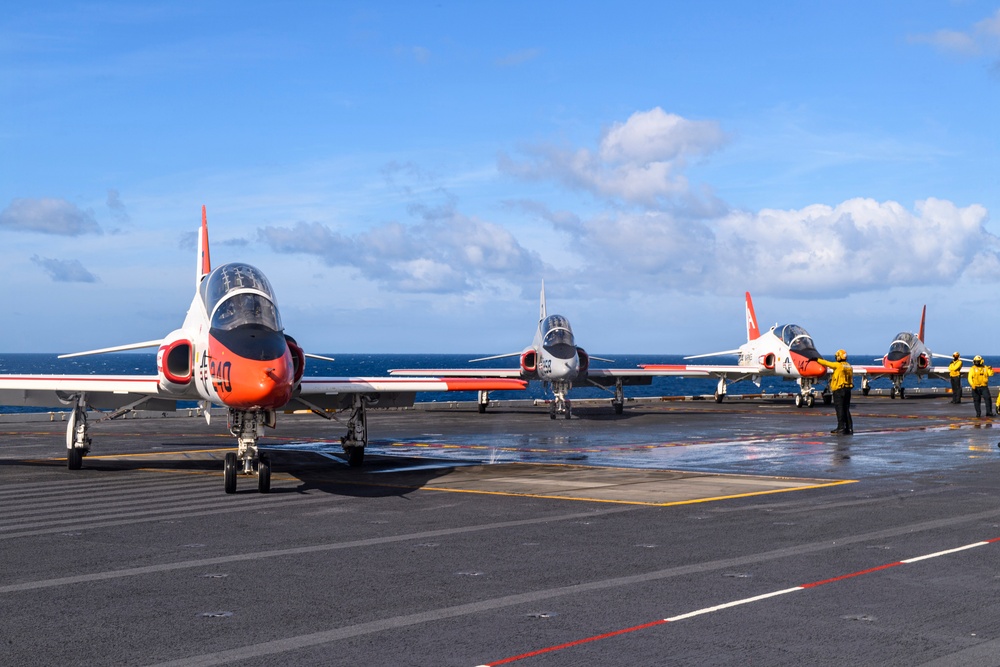
USS Nimitz returned to Naval Station Norfolk on Nov. 9 after a training underway that brought carrier-qualification work for new and experienced naval aviators together on one flight deck. The Navy reported 103 sorties, 442 arrested landings and 152 touch-and-goes during the period, which it described as the carrier’s first East Coast training underway supporting qualifications for both groups.
The deployment’s value was the range of aviators it supported. Fleet pilots preparing to join operational units, aviators returning to carrier flying after non-flying sea assignments, and student pilots in Navy training wings all used the ship during the underway. It was also part of Nimitz’s changed role after its move to Norfolk: the carrier is scheduled to conduct additional qualification underways before its eventual deactivation.
One underway served several stages of naval aviation
After a short recertification of its Carrier Air Traffic Control Center, Nimitz began with qualifications for Carrier Air Wing 1 and Strike Fighter Squadron 106, known as the “Gladiators.” VFA-106 is a fleet replacement squadron, where pilots train to transition to the F/A-18E/F Super Hornet before joining fleet units. The Navy said the event included aviators heading to the fleet for the first time and others returning to flying after “disassociated” sea tours—assignments at sea that do not involve regular flight duties.
For first-time Super Hornet aviators, the underway provided their initial carrier catapult launches and arrested recoveries in the aircraft. Returning aviators used the period to regain carrier qualifications after time away from operational flying. The carrier’s air boss, Cmdr. Michael Farley, told the Navy that those who qualified would be prepared for their next fleet assignments, whether they were joining the fleet for the first time or bringing previous deployments with them.
T-45C students practiced carrier operations at sea
After the air wing and fleet-replacement squadron phases, Nimitz supported student naval aviators from Chief of Naval Air Training Training Air Wings 1 and 2. The students flew T-45C Goshawk trainers and practiced carrier launches and landings for the first time. A Navy photograph from Nov. 4 shows T-45C aircraft on the flight deck during the student qualification period.
Carrier qualification is a distinct step in preparing pilots for shipboard operations. A carrier flight deck is short, moving, and busy; pilots must coordinate with the ship’s flight-control team and land within a narrow area using the arresting system. The Navy’s training command describes carrier qualification as the culmination of the T-45C strike-training syllabus, where students make their first arrested landings at sea. The underway brought that student stage alongside Super Hornet qualification and requalification activity for fleet aviators.
The activity totals describe the whole underway
The Navy’s figures—103 sorties, 442 arrested landings and 152 touch-and-goes—cover the overall underway. They are not a count of pilots who qualified, and the service did not publish a breakdown by aircraft, squadron, or training group. An independent account by Defense WarRoom likewise cautioned that the totals were not separated by unit and should not be read as the number of completed qualifications.
The figures show the amount of flight-deck activity the ship supported, but they do not by themselves indicate how many individual aviators completed every required event. A sortie is a flight; an arrested landing is a recovery using the carrier’s arresting gear; and a touch-and-go is a deck contact followed by a takeoff rather than a full arrested recovery. The categories reflect different parts of carrier aviation training and should not be added together as if they represented separate flights or separate pilots.
The mixed training load matters because the ship supported a fleet replacement squadron and student training wings during the same underway. The Super Hornet pilots were working toward or back toward fleet flying, while T-45C students were taking an early step toward carrier operations. The Navy’s release does not say how the flight schedule was divided among them, so the totals are best understood as a measure of the full operation rather than of any one training pipeline.
Nimitz is being used as a training carrier in its final service period
The November underway fits a broader transition for Nimitz. The Navy says the carrier is expected to conduct several more carrier-qualification underways before deactivation. In July, USNI News reported that the ship’s final period of service would include a training role after its homeport shift to Norfolk. The latest Navy account confirms that the carrier has now completed its first East Coast training period of this kind.
Keeping an experienced carrier and crew available for qualifications gives the Navy a dedicated at-sea setting for pilots who need to demonstrate shipboard launch and recovery skills. It also allows one underway to serve people at different points in their careers. The Navy has not released dates for the remaining qualification periods or detailed how many pilots were qualified in November, so those details remain open.
For now, the documented result is a completed training period and a return to Norfolk, with more qualification work planned before the carrier’s deactivation. The Navy’s account and independent coverage describe the same core event; the new operational detail is how the carrier combined student T-45C practice with Super Hornet qualifications and requalifications in a single underway.
Sources
- U.S. Navy / DVIDS: “Nimitz Trains New, Returning Naval Aviators,” Nov. 9, 2026
- Defense WarRoom: USS Nimitz carrier qualifications, Nov. 9, 2026
- Defence Industry Europe: Nimitz completes first East Coast training period, Nov. 9, 2026
- Chief of Naval Air Training: Strike Flight Training and carrier qualification syllabus
- USNI News: Nimitz arrives in Norfolk for homeport shift, July 9, 2026

No comment