
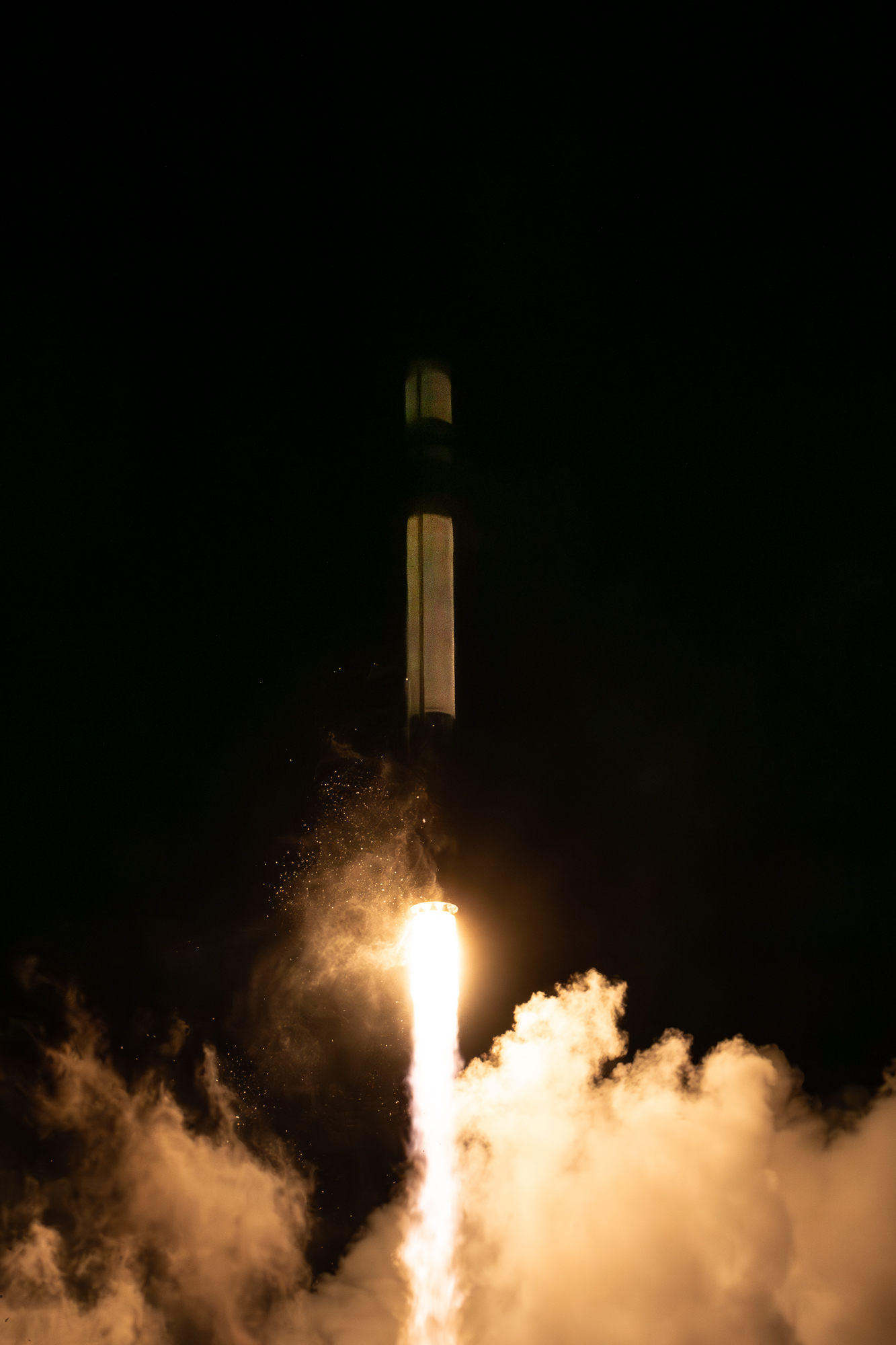
Rocket Lab is targeting Nov. 14 for the 100th launch of its Electron rocket, a milestone the company says would make Electron the first commercially developed small-lift orbital vehicle to reach that flight count. The mission, named “The Mountain God Rises,” is scheduled to lift off from Launch Complex 1 on New Zealand’s Māhia Peninsula and carry a QPS-SAR Earth-imaging satellite for Japan’s Institute for Q-shu Pioneers of Space (iQPS).
Rocket Lab’s Nov. 12 announcement sets the planned liftoff for 6:30 p.m. New Zealand Daylight Time on Nov. 14. The company’s mission page lists a 575-kilometer low-Earth orbit and a 42-degree inclination. As of publication, the flight remained scheduled; weather, range conditions and technical readiness can still affect a launch date.
A century mark reached through dedicated flights
Electron first flew in 2017. The Nov. 14 mission follows the rocket’s 99th flight, “The Sea God Surveys,” which launched on Nov. 2 with another iQPS radar-imaging satellite. Rocket Lab said that was the company’s 20th Electron mission of 2026 and its 10th consecutive successful Electron launch for iQPS. Space.com’s coverage of the 99th launch independently reported the satellite deployment and the approaching 100-flight mark.
The planned 100th mission is therefore both a vehicle milestone and the next installment in a recurring commercial launch relationship. iQPS is building a synthetic aperture radar (SAR) constellation. Rather than relying on reflected sunlight, SAR instruments transmit microwave energy and measure its return. That lets radar satellites collect imagery at night and through many cloud conditions, a capability that complements optical Earth-observation systems. The European Space Agency’s SAR overview explains the difference between radar imaging and sensors that depend on visible light.
Rocket Lab describes the upcoming payload as one QPS-SAR satellite, destined for the constellation’s 575-kilometer orbit. The company says iQPS uses the network to provide high-resolution, near-real-time radar imagery. Those are company descriptions of the service; the mission page does not specify the spacecraft’s individual resolution, revisit interval or particular customer applications. The more limited public information is still enough to show why a commercial operator might choose a dedicated launch: the customer can reserve a mission for its payload and target orbit instead of waiting for a shared ride whose schedule and orbit are set around other satellites.
What Electron’s flight rate says—and does not say
A rocket’s cumulative launch count is a useful measure of operational cadence, but it does not by itself establish that every flight is identical or that a vehicle is risk-free. Electron’s record has been built through a series of missions with different customers and payloads, and the 100th flight will still be a single launch whose outcome has not yet been determined. Rocket Lab’s claim that Electron would be the fastest commercially developed rocket to reach 100 launches is a company comparison; the public release does not provide a side-by-side methodology for all commercial launch vehicles.
The rocket has features that distinguish its approach to small-payload service. Rocket Lab says Electron uses carbon-composite structures and Rutherford engines, which are manufactured using 3D printing and use electric pumps. The company also operates launch sites in New Zealand and Virginia. Its dedicated-flight model is intended to give small-satellite operators greater control over timing and orbit than they might receive on a rideshare mission. That flexibility comes with tradeoffs: a dedicated launch carries the cost of an entire rocket and mission, while a rideshare can divide launch costs among customers but may offer less schedule and orbital control.
The launch cadence has continued while Rocket Lab develops Neutron, a larger vehicle designed for a different market. The two programs should not be conflated: Electron is an operating small-lift launcher, while Neutron remains in development. The 100th Electron mission would mark progress in the company’s current service line, not completion of its broader vehicle roadmap.
Why iQPS is returning to Electron
The November flight is scheduled to be Rocket Lab’s 11th dedicated Electron mission for iQPS since 2023, according to Rocket Lab’s announcement and mission records. The previous mission deployed another QPS-SAR spacecraft, extending a sequence in which the Japanese operator has used Electron to add satellites to its radar constellation. Rocket Lab’s launch ledger lists “The Sea God Surveys” on Nov. 3 local New Zealand time and “The Mountain God Rises” as the next iQPS flight, planned for Nov. 14.
Repeated launches for one customer can indicate that a launch provider is matching a customer’s deployment plan, but the public information does not reveal the commercial terms or the satellite’s performance requirements. Rocket Lab has previously announced a multi-launch iQPS agreement, and the operator has continued to order additional flights. For constellation builders, the practical issue is not only getting one spacecraft into orbit; it is sustaining a deployment sequence so that satellites can be added, replaced or repositioned over time. The 100th-flight mission places that commercial relationship in the foreground because its payload and its milestone are tied together in a single flight.
SpaceNews’ Nov. 3 report on the 99th Electron flight likewise framed the launch as a step toward the century mark and described iQPS’s radar satellite deployment. NASASpaceflight’s Nov. 9 launch preview lists “The Mountain God Rises” as Electron’s 100th mission and gives the planned Nov. 14 date. Rocket Lab’s newer update provides the more current launch time.
A scheduled milestone, still subject to launch conditions
Rocket Lab has said the launch broadcast will begin about an hour before liftoff, with live coverage on its official YouTube channel. The company’s current published schedule places the launch at 6:30 p.m. in New Zealand on Nov. 14, which is 5:30 a.m. UTC and 12:30 a.m. Eastern Time on Nov. 14. The schedule may move; readers should check the mission page for updates before treating the time as final.
If Electron flies as planned, the mission will add a new entry to the vehicle’s record while carrying a radar-imaging satellite for an operator that has repeatedly chosen dedicated launches. The milestone is notable because it combines two questions central to commercial spaceflight: whether a small orbital launcher can sustain frequent operations, and whether satellite operators can build constellations through a dependable series of tailored missions. The answers depend on execution over many flights, not the round-number count alone.
Archival photo note: The featured image shows an Electron launch for NASA’s PREFIRE mission on May 25, 2024; it is not a photograph of the upcoming 100th-flight vehicle or the Nov. 14 mission. Photo credit: Rocket Lab. Used for media reporting under Rocket Lab’s published image permission; see the Rocket Lab imagery and video usage terms and the original NASA/Kennedy Space Center image record.
Sources
- Rocket Lab: 100th Electron launch announcement
- Rocket Lab: “The Mountain God Rises” mission page
- Rocket Lab: mission and launch history
- Space.com: coverage of Electron’s 99th mission
- SpaceNews: Electron nears century mark with iQPS launch
- NASASpaceflight: Nov. 9 launch preview
- European Space Agency: synthetic aperture radar missions


No comment