
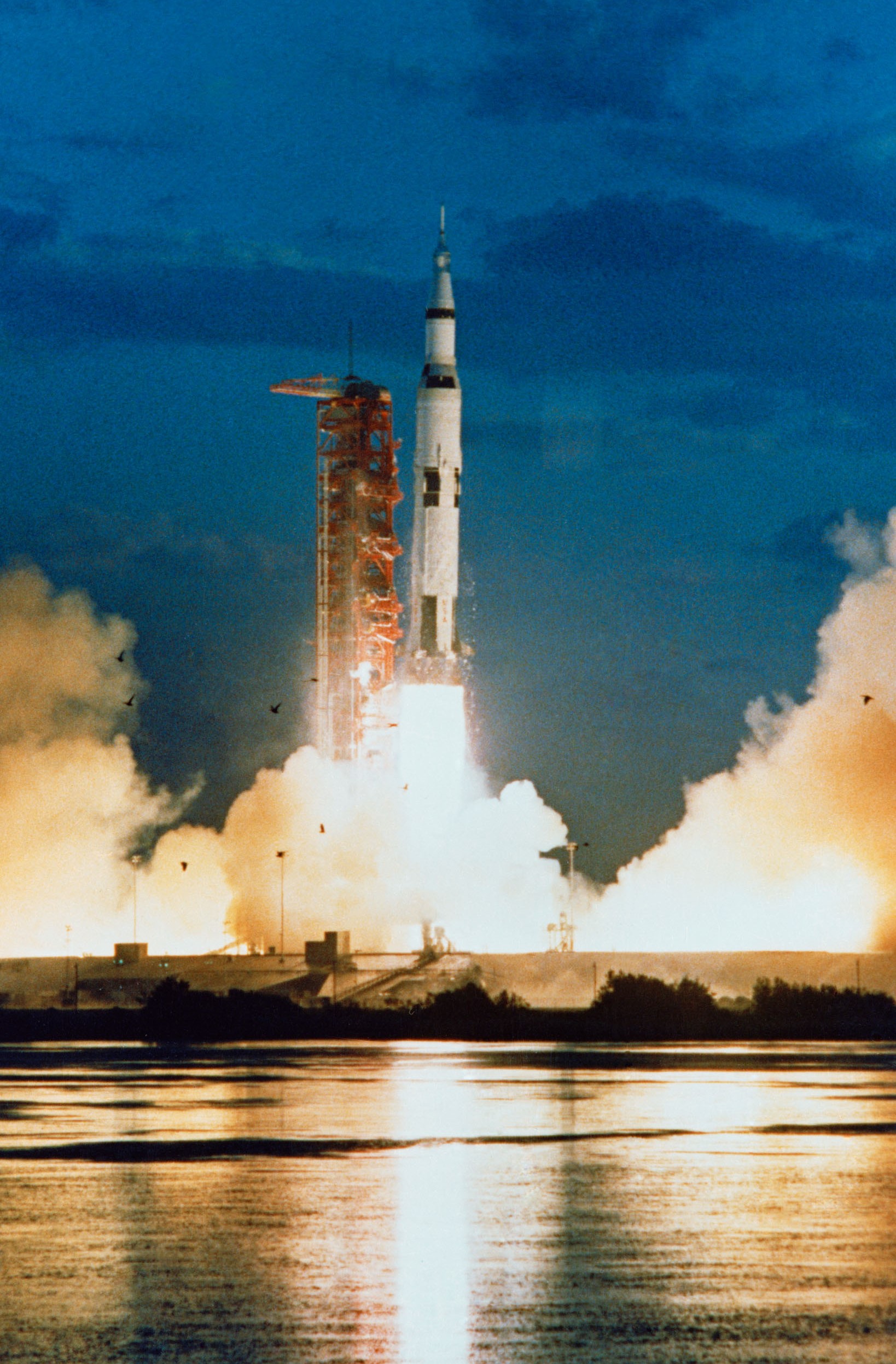
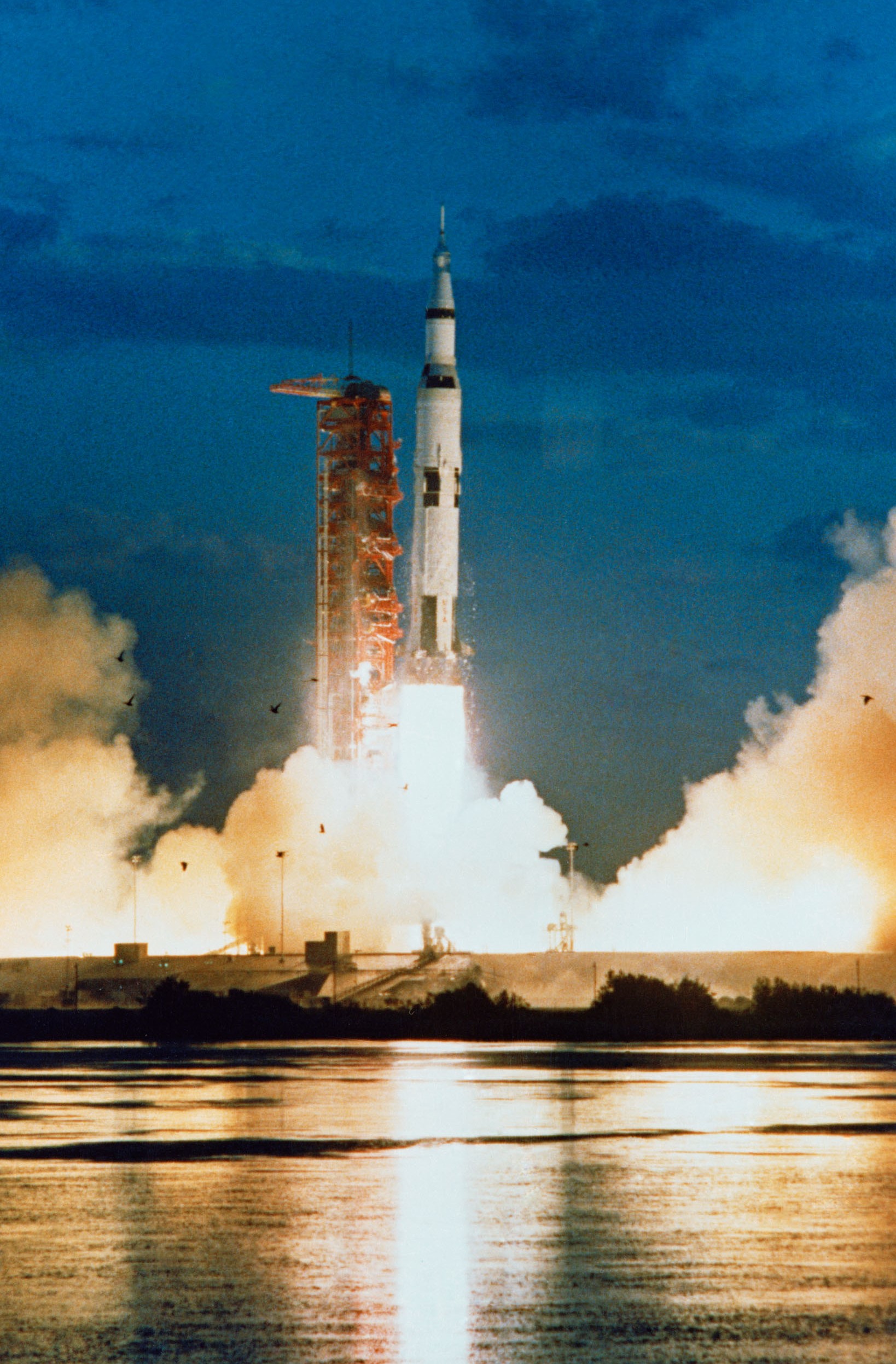
Featured photo: The first Saturn V rocket lifts off from Launch Complex 39A at NASA’s Kennedy Space Center in Florida on the uncrewed Apollo 4 mission, November 9, 1967. Photo: NASA (S67-50433)
At 7 a.m. Eastern time on November 9, 1967, the five F-1 engines at the base of a 363-foot rocket roared to life on Launch Pad 39A at NASA’s Kennedy Space Center in Florida. Seconds later, the first Saturn V began its slow climb skyward. The flight, known as Apollo 4, carried no crew, but it was the rocket that would later send astronauts to the Moon, and NASA’s history office calls it “one giant leap forward” for the program.
An “all-up” gamble
NASA’s usual practice had been to test fly each stage of a new rocket on its own before launching a complete stack. For the Saturn V, managers chose what they called an “all-up” approach: test all three stages for the first time on a single launch. That included restarting the third stage in orbit, a capability later crews would need to head toward the Moon.
The mission also tested the Apollo Command and Service Module. Managers especially wanted to check the spacecraft’s main engine, which crews would rely on to enter and leave lunar orbit, and the Command Module’s heat shield, which would have to survive a return through Earth’s atmosphere at about 25,000 miles per hour. There was no working Lunar Module aboard, but a test article rode inside the adapter beneath the spacecraft to collect loads and vibration data during the climb to orbit.
Months on the pad
The Apollo 4 Saturn V rolled out to Pad 39A on August 26, 1967. A planned six-day rehearsal of the final countdown began on September 29 but ran until October 14 because of a string of unexpected problems, including faulty power-producing fuel cells in the Service Module that had to be replaced. Further issues pushed launch day from November 7 to November 9. NASA notes that the lessons from that long rehearsal paid off with a fairly trouble-free countdown for the real launch, monitored from Firing Room 1 of Kennedy’s Launch Control Center.
Loud enough to rattle the press site
The first stage’s engines produced 7.5 million pounds of thrust. NASA reports that scientists calculated the launch noise was one of the loudest ever, natural or man-made, and the vibrations rattled the press site several miles away. Once the rocket cleared the tower, control passed to Mission Control in Houston, where Flight Director Glynn S. Lunney led the team.
About two and a half minutes after liftoff, at 40 miles up, the first stage burned out and fell away, an event recorded by recoverable film cameras on the second stage. The second stage’s five J-2 engines then burned for six minutes, and the third stage’s single J-2 engine placed Apollo 4 into a near-circular orbit about 115 miles high.
A simulated return from the Moon
After two orbits, the third stage fired again, right on time, throwing the spacecraft into a long, looping orbit that reached more than 10,000 miles from Earth. The spacecraft then separated, fired its own engine to climb higher still, and turned to put maximum heat stress on its heat shield. Near the high point of that orbit, an onboard camera took 715 color images of Earth.
On the way down, the spacecraft fired its main engine a second time to push its speed to roughly what a returning Moon mission would see. The Command Module hit the upper atmosphere at nearly 25,000 miles per hour. NASA reports its heat shield reached about 5,000 degrees Fahrenheit while the cabin stayed comfortable enough for a crew. The capsule even skipped briefly back up out of the atmosphere before continuing down, a technique that reduced heating and deceleration.
Apollo 4 splashed down in the Pacific Ocean near Hawaii, upright, after a flight of roughly eight and a half hours. The prime recovery ship, U.S.S. Bennington, hoisted the capsule aboard. Today the Apollo 4 Command Module is on display at the INFINITY Center at NASA’s Stennis Space Center in Mississippi.
Why it still matters
Apollo 4 came less than a year after the Apollo 1 fire, and NASA says its success reinvigorated the Moon landing program and paved the way to meeting President John F. Kennedy’s goal before the end of the decade. President Lyndon B. Johnson said, “The whole world could see the awesome sight of the first launch of what is now the largest rocket ever flown.”
The mission’s playbook is still in use. NASA points out that the December 2014 test flight of an uncrewed Orion spacecraft followed a profile similar to Apollo 4’s, and the Artemis program’s first flight was another uncrewed test of Orion before astronauts climb aboard. It all started with one very loud morning on Florida’s Space Coast, a little over an hour’s drive from Skylord’s home in Central Florida.

No comment