
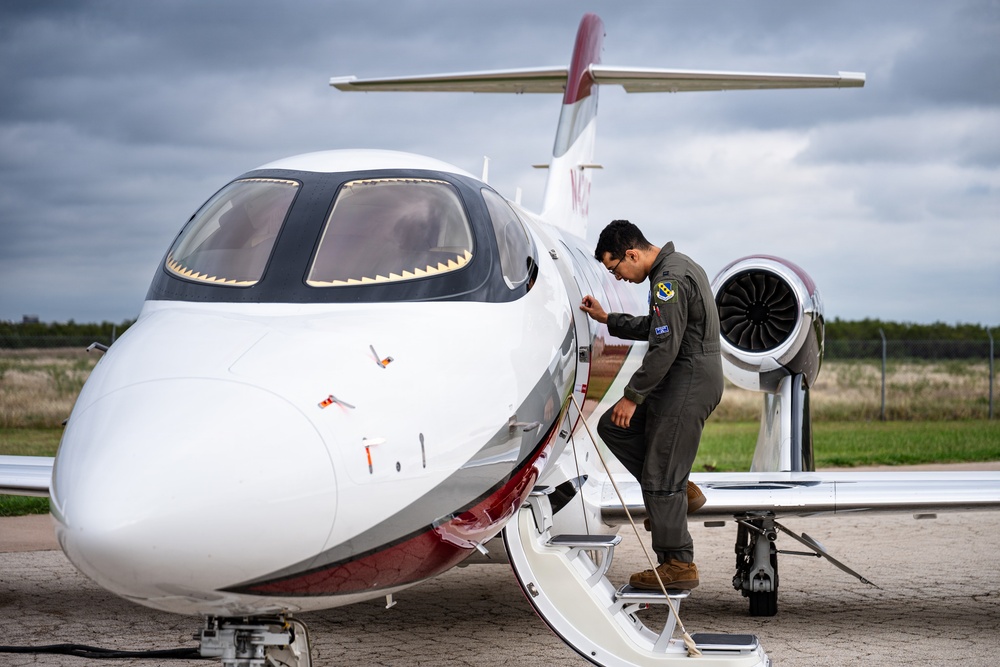
Ask any pilot what keeps their skills sharp and the answer rarely changes: time in the air. Not time in a briefing room, not time in a simulator, but real hours with real weather, real traffic, and real decisions that cannot be paused. That simple truth sits at the center of a new Air Force program that has B-1B Lancer pilots climbing out of the bomber and into a light business jet.
In the first week of November, Air Force Global Strike Command launched the Bomber Supplemental Trainer for Aircrew Readiness, or BSTAR, at Abilene Regional Airport in Texas. The idea is straightforward: give B-1 pilots from nearby Dyess Air Force Base extra flying hours in a smaller, contractor-operated jet, while saving the big bomber’s flight hours for the mission-specific training only the B-1 can provide.
A first flight, then the generals
According to the Air Force story published on DVIDS, the program reached its first milestone on Nov. 2, when a Dyess B-1 pilot completed the inaugural military training flight. Two days later, Gen. S.L. Davis, commander of Air Force Global Strike Command, and Maj. Gen. Ty Neuman, commander of Eighth Air Force and the Joint-Global Strike Operations Center, flew observer flights to see the capability for themselves.
Official Air Force photo captions from the launch identify the aircraft as a HondaJet HA-420, one of the light business jets now flying from Abilene for the program.
“Combat-ready aircrews are built on foundational airmanship, sound decision-making and time in the air,” Davis said in the Air Force release.
Back to the fundamentals
BSTAR flights focus on the basics that every aviator depends on: instrument procedures, mission planning, aircraft handling, and crew resource management. The Air Force says the prototype is expected to provide approximately 100 additional flying hours per pilot each year.
The command is careful to say what BSTAR is not. It complements, rather than replaces, existing B-1 training, and the flights do not substitute for B-1 sorties or reduce the requirement for bomber availability. Skills such as aerial refueling, tactical employment, and weapons delivery still have to be learned and practiced in the B-1 itself.
Simulators also keep their place. The Air Force notes that simulators remain essential for practicing complex systems and mission scenarios, but that live flying adds experience with changing weather, air traffic, and real-time decisions in the cockpit. One B-1 pilot who flew the first sortie put it plainly: working through instrument procedures and making decisions in real time “reinforces skills we rely on as pilots.”
Col. Robert Sturgill, commander of the 7th Bomb Wing and Dyess, summed up his view in one line: “I want our pilots flying as much as possible.”
Who flies the jets
BSTAR uses a contractor-owned, contractor-operated model. XSTAR Aviation provides the aircraft, instructor pilots, maintenance, and scheduling, and the flights do not require additional B-1 aircraft or military maintenance personnel. On its website, XSTAR describes itself as a subsidiary of SBCC, created out of the findings of the BSTAR study conducted under Air Force Global Strike Command. Its listed leadership team includes several retired Air Force general officers and a retired lieutenant colonel serving as lead instructor pilot.
Why the B-1 community is a good test case
The B-1B is a demanding airplane. The Air Force fact sheet describes it as a long-range, multi-role heavy bomber with variable-geometry wings, four General Electric F101 afterburning turbofans, and a crew of four. It is a big, complex, and expensive machine to fly, and its hours are valuable. The first B-1B was delivered to Dyess Air Force Base in June 1985, so the Texas base has been home to the Lancer for roughly four decades.
Pairing that heavy bomber with a compact business jet may sound unusual, but the logic will be familiar to anyone in general aviation. Airline pilots, corporate crews, and weekend flyers all know that proficiency fades without regular flying, and that the fundamentals transfer from one cockpit to the next. A clean instrument approach in gusty Texas wind is good practice no matter what is painted on the tail.
What comes next
BSTAR is a prototype. The Air Force says sorties will be tracked and debriefed throughout the prototype period, with aircrew feedback used to refine flight profiles and evaluate training effectiveness. Those findings will help Air Force Global Strike Command decide whether supplemental flight training can play a broader role in developing combat-ready B-1 aircrews.
For Skylord, the story is a reminder of something easy to forget in an era of advanced simulators and digital cockpits. The most sophisticated aircraft in the world still depend on the oldest skill in aviation: a pilot who has spent enough time in the sky to make good decisions when it counts. Sometimes the best way to sharpen that skill is a smaller airplane and a lot more flying.
Have an aviation scoop or story tip? Skylord Magazine is always looking for stories from pilots, crews, and the people who keep them flying. If you have a tip, or would like to be interviewed for an article, we would love to hear from you.
Read the original Air Force release: AFGSC expands B-1 pilot training through new aviation initiative (DVIDS).
Sources
- Master Sgt. Dana Cable, Air Force Global Strike Command / 7th Bomb Wing, “AFGSC expands B-1 pilot training through new aviation initiative,” DVIDS, posted Nov. 5, 2026: dvidshub.net/news/578744
- DVIDS photo 10074213, “A U.S. Air Force B-1B Lancer pilot boards a HondaJet HA-420…,” U.S. Air Force photo by Senior Airman Jade M. Caldwell, Nov. 2, 2026 (public domain): dvidshub.net/image/10074213
- DVIDS photo 10074252, “A HondaJet HA-420 departs Abilene Regional Airport…,” Nov. 4, 2026: dvidshub.net/image/10074252
- U.S. Air Force, “B-1B Lancer” fact sheet: af.mil
- XSTAR Aviation, “Who We Are”: xstaraviation.com/about




No comment